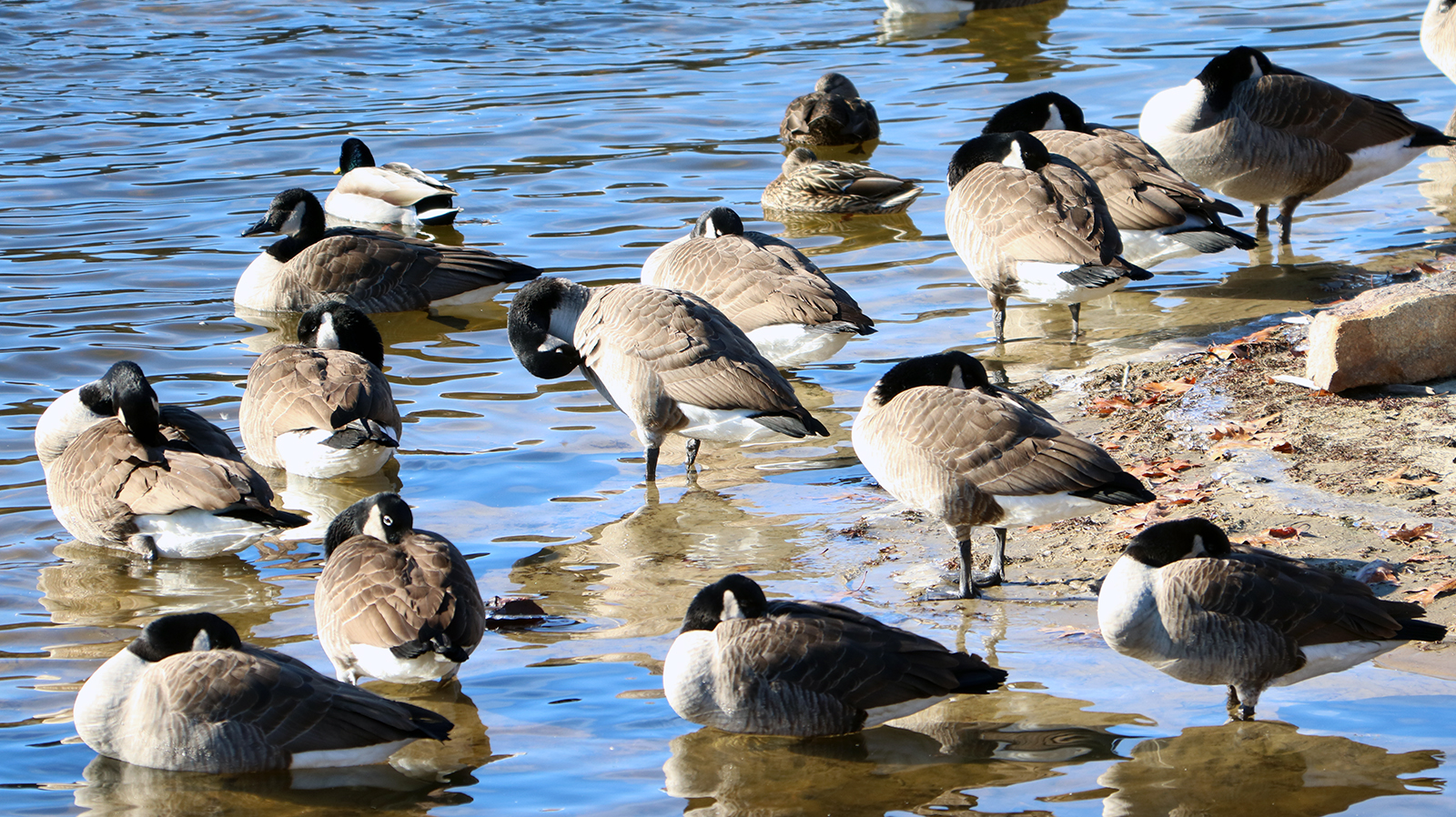
On December 5, 2025, the weather in Lowell is 19 degrees and sunny. It's the coldest day of the fall season thus far.
When I arrived at the river’s edge, I saw about a dozen American Black Ducks. It was my first sighting of these relatives of the Mallards since last March. The species has been on the decline since the mid-twentieth century for various reasons.
On this day, there are several American Blacks gliding along the river's edge. They're easily recognizable by their dark brown plumage and their tendency to drift away from oncoming humans, away from the shore toward the center of the river where their survival instincts indicate it's safe. Nevertheless, they evoke a lovely scene of tranquility by their subtle movements.
The gulls and the Mallards are ubiquitous as usual. Gulls take up residence on and near the various islands adjacent to the Lawrence Mills area. The Mallards are migrators, about 50 in all. They spread out and form groups up by the Aiken Street bridge. The Mallards are more animated than usual, with some braving the riffles, allowing themselves to be swept up by the current and swirling about with only their heads exposed.
Today’s weather is ideal and the habitat is suitable—no desirable—for all comers.
Overnight, a flock of over 50 Canada Geese had swooped in for a quick goose-nap. Most are sleeping along the shore on the Centralville side of the river—resting after a long journey from parts unknown. Several in that contingent are moving about and dabbling, but most are snoozing while standing in the shallows along the river’s edge in a calm pocket by an elongated island. Several American Blacks and a few Mallards join the sleeping geese. It's a lovely and peaceful sight.
The Common Goldeneyes are over 50 strong now—a self-contained amalgamation drifting about enmass in a shifting gel-like formation. They spend their days diving, foraging, resting, and socializing—and moving from one location to another. Like the American Black Ducks, they too are skittish of humans and the various shadows picked up along the shoreline in the radar-like sightlines of their near 360 degree peripheral vision.
My childhood friend John Donahue recently asked how many “ducks” were on the Merrimack River in Lowell last winter. The short answer is there were too many to count along my beat. And there were sightings farther upstream by the Bellegarde Boathouse and in the Concord River and even in the canals—as well as in the waterways in the adjacent cities and towns. No one appears to be counting, so it's impossible to know "how many" overall.
But last winter, the arctic ducks didn’t arrive on the stretch of river between the bridges in Lowell until January 12, 2025.
This season, the Common Goldeneyes began arriving on November 18—only four male vanguards at first. After almost three weeks, there are now 57, more or less, and mostly females. A few Buffleheads have joined the goldeneyes so far this season. There will likely be more.
So, to answer John’s question—if I were to guess—at the peak, which occurred in mid-February, there may have been somewhere between 500–600 ducks, geese, swans, and gulls on this stretch of the river. The number grew throughout the winter even with the coming and going of migrators on any given day.
Today, there are well over 200 waterfowl out there. Whether that number will grow or recede is anyone’s guess. But the current trend piques my curiosity. I'll be more cognizant of the approximate numbers going forward, though it'll be difficult to poinpoint them in exact terms.
For example, last winter, a variety of species of diving ducks were drawn to this section of the river. They included Common Goleneyes, Buffleheads, Common Mergansers, Hooded Mergansers, Ring-necked Ducks, and Scaups.
A family of Mute Swans also arrived last season, thus joining the dabblers: the Canada Geese, Mallards, and American Black Ducks.
A pair of young swans arrived on the river on November 18, just a few weeks ago. But they only stayed that one day. Will they return? Who knows? The presence of the Mute Swan family last season added a vital texture to the magical proceedings, as they played out.
So, it’s too early to tell how this season is going to turn out. But so far, the early arrival of the Common Goldeneyes offers promise for another winter of symbiosis for the waterfowl that seek sustenance and solace on the Merrimack River.
Only time will tell but, so far, the conditions on the river are favorable and the outlook is encouraging.